

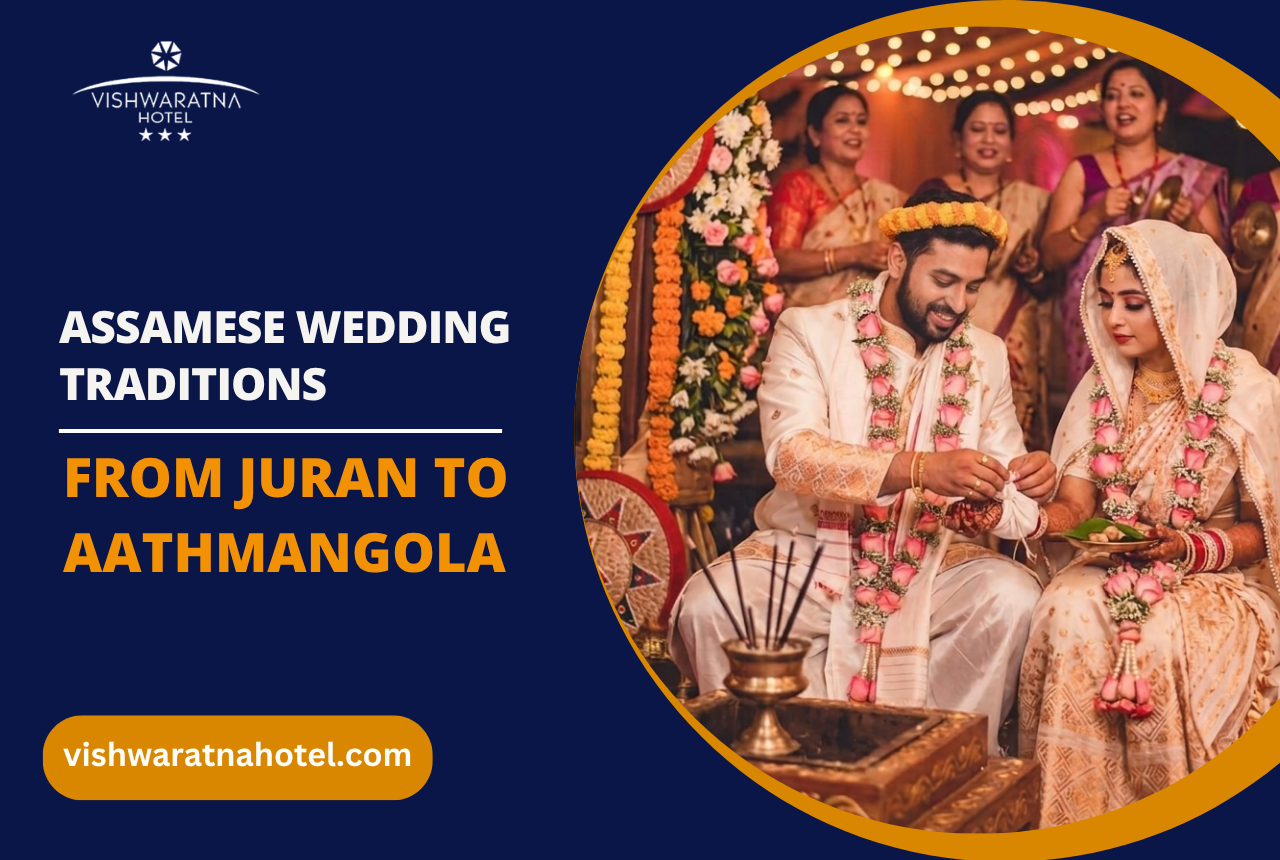
If you’ve ever been lucky enough to witness an Assamese wedding, you already know — there’s nothing quite like it. Known locally as Biya, an Assamese wedding is an intimate, culturally layered celebration that unfolds across two to three days, sometimes more. It is rooted deeply in Vedic tradition, yet unmistakably shaped by the unique soul of Northeast India.
Far from the loud, elaborate productions seen elsewhere in the country, an Assamese wedding carries a quiet elegance — the kind that lingers. The air is filled with the sound of conch shells, the gentle rhythm of Biya Naam (traditional wedding songs sung by women), and the warm, earthy fragrance of turmeric and mustard oil. It is a celebration that draws entire communities together, honoring not just two individuals but the union of two families, two ancestral lines, and two futures.
For guests traveling from outside Assam, Guwahati — the gateway city of the Northeast — is the ideal base. Hotels like Vishwaratna Hotel, situated right in the heart of Guwahati, offer a comfortable stay for families and guests attending weddings across the region, with easy access to all corners of the city and beyond.
Whether you’re planning your own Assamese wedding, attending one, or simply curious about one of India’s most distinctive traditions, this guide covers everything: pre-wedding rituals, the wedding day itself, post-wedding customs, and the stunning traditional attire worn by the Assamese bride and groom.
What is an Assamese Wedding (Biya)?
Assamese wedding ceremonies are referred to as Biya in the native language of the state. They are subtle, simple, and yet an elegant affair, with rituals firmly grounded in the culture, spanning about two to three days. The traditional wedding song is known as Biya Naam, and Uruli — a sound made by ladies rolling their tongues — is another essential element of the celebration.
The state is an amalgamation of different religions, cultures, and languages, and many of the rituals in Assamese weddings are based on Hindu scriptures, yet distinctly different from the rest of the country because of the assimilation of unique regional communities.
Pre-Wedding Rituals
The wedding journey begins days before the actual ceremony, with a series of beautiful traditions that prepare both families and the couple for the big day.
1. Juran Diya
The pre-wedding ceremonies begin with Juran Diya, a significant ritual that takes place one or two days before the wedding. During this ceremony, the groom’s mother, accompanied by female relatives, visits the bride’s house. She brings gifts for the bride, including betel leaves and nuts (Pan and Tamul), a traditional Assamese cloth called Gamusa, and other items. This ceremony symbolizes the acceptance of the bride into the groom’s family.
In the morning on the day of Juran, strings of mango leaves are tied over every door of the house to absorb negative energy from anyone entering. This is known as Aaam dali gatha.
2. Tel Diya
Tel Diya is one of the most distinctive rituals in all of Assamese tradition. In Assam, it is customary for the groom’s mother to perform the Sindoor ritual instead of the groom. In the Tel Diya ritual, the groom’s mother puts a ring and betel nut on the bride’s forehead and pours oil thrice. She then applies sindoor and gives the wedding trousseau — the personal possessions of the bride — including the Mekhla Chadar and traditional Assamese jewelry such as Gol Pota, Jon Biri, Bena, Gaam Kharu, Loka Paro, and Thuria.
3. Pani Tola (Sacred Water Collection)
In the Pani Tola ceremony, the mothers of the bride and groom head to a nearby pond or water source to collect water while other women walk with them, singing traditional Biya Naam. On their trip, they must carry a brass candlestand with a diya, rice, betel nuts and leaves, a coin, and a knife.
The atmosphere during this ritual is joyful, almost festive — a procession of women moving through the neighborhood at dawn, their voices carrying wedding songs that echo through the streets.
4. Nuoni (Ceremonial Bath)
Nuoni is a function that combines elements from the North Indian Haldi and South Indian Mangal Snanam rituals while adding customs unique to Assam. The bride and groom bathe in the water from the Pani Tola, with their mothers applying oil, curd, and maah-halodhi — a paste of lentils and turmeric — on their face and arms.
Wedding Day Rituals
The wedding day itself is packed with ceremony from the early morning hours. It begins with ancestral prayers and builds to the sacred fire ceremony at the mandap.
Nau-Purush Shardha (Ancestral Blessings)
Observed on the wedding day, the Nau-Purush Shardha is performed by the fathers of both the bride and groom. This special ceremony honors the last nine generations of ancestors from the groom’s father’s side and the last three generations from the mother’s side — an invitation to departed souls to attend this auspicious occasion.
Daiyan Diya (The Curd Ritual)
The groom’s family sends curd to the bride’s house early in the morning. She eats a portion of it and sends the rest back for the groom — the last meal for both of them as singles before tying the knot.
Reception Before the Wedding
One of the most unique quirks of Assamese weddings is the timing of the reception. Another unique aspect of weddings in Assam is that they have a reception before the wedding. The couple invites their family and friends for a celebration, offering them saunf or fennel per tradition.
Arrival of the Groom (Dora Aaha)
Through a series of fun-filled games and playful teasing, the groom finally steps inside the wedding hall in a ceremony called Dora Aaha. As he arrives, the bride’s family welcomes him with traditional Assamese music and dance, and applies tilak on his forehead as a mark of respect and blessing.
The groom’s shoes being “stolen” by the bride’s family — and the ensuing friendly negotiation — is a beloved highlight that brings laughter and lightness to the proceedings.
Bhori Dhuwa & Jaimala
In the custom of Bhori Dhuwa, the groom’s feet are washed as a sign of respect and acceptance by the bride’s family. This is followed by the Jaimala ceremony, where the regal Assamese bride places a garland around the groom’s neck, and the groom does the same.
The Main Ceremony: Saptapadi (Seven Pheras)
The bride’s brother hands her puffed rice that she places in the fire as an offering to the gods. The next ritual is the Saptapadi, where the bride and groom walk around the holy fire seven times. Each circle stands for a wedding vow they make to each other. The groom’s Cheleng is tied to the bride’s dupatta, and they take turns walking in front. The bride also steps on seven betel leaves with her right foot for good luck for seven lifetimes.
So to answer a common question: Assamese weddings follow 7 pheras (Saptapadi), not 4 — a full seven rounds around the sacred fire, each representing a distinct vow.
Agni (fire) is considered a witness to the marriage vows. The vows cover different aspects of Vedic marriage — from promising to always do the right thing to supporting each other’s growth, staying loyal, building a family, and navigating life’s ups and downs together.
Post-Wedding Rituals
The wedding doesn’t end with the ceremony. Some of the most heartfelt moments happen in the days that follow.
Bidaai (Bride’s Farewell)
After the wedding ceremony, the bride bids a tearful goodbye and throws handfuls of rice over her shoulder to symbolically repay the debt of her upbringing to her parents. The couple then moves to the groom’s house.
Ghor Gosoka (Welcome at the Groom’s Home)
When the couple arrives at the husband’s home, they perform a series of post-wedding rituals, including the Ghor Gosoka, where the bride steps on a flat dish filled with milk and enters the home by breaking a Saaki — a clay lamp.
Khuba Khubi
The groom arrives at the bride’s house the next morning for the ritual of Khuba Khubi. The priest narrates the story of two goddesses, Khuba and Khubani, at the end of which the couple seeks blessings from the gods. The couple then prepares for the reception in the evening, and the bride finally leaves her father’s house.
Phool Soja (The Flower Room)
The couple’s bedroom is beautifully decorated with flowers for their first night together — a tender tradition called Phool Soja.
Aathmangola (The Eighth Day Ceremony)
The Aathmangola ceremony is the last post-wedding ritual, typically held on the eighth day after the wedding. The newlywed couple and the groom’s family visit the bride’s family home. The bride’s parents invite family and friends to wish the couple well, and elders bless them and share advice on happy marriage.
The ceremony ends with an elaborate feast including traditional dishes such as Masor Tenga (a tangy fish curry), Khar (raw papaya and mustard greens), and Aloo Pitika (mashed potato).
Traditional Attire: The Assamese Bride and Groom
The Assamese Bride
The Mekhela Chador is typically made from Muga, Pat, or Eri silk and embroidered with heavy gold and silver zari. While ivory or off-white colors are the traditional choice, the bridal ensemble can also come in pastel shades, reds, and greens. The designs are often inspired by Assamese flora, fauna, and folklore, as well as local Jaapi and Gamosa motifs.
No Assamese bridal look is complete without traditional gold jewelry. Classic pieces include Jon Biri (a heavy gold chain with a moon-shaped pendant), Dholbri necklace (with silk beaded threads and a drum-shaped pendant), Golpata (a floral choker), Kerumoni (a long necklace), and Loka Paro (a beaded necklace with pigeon-shaped pendants).
The Assamese Groom
The groom wears a traditional silk dhoti and kurta, and drapes a Cheleng — a traditional Assamese-style shawl — over his shoulders. All of these outfits are preferred in Muga Silk, a rare fabric of Assam once reserved only for royalty. An Assamese groom also wears a wreath and garland of Indian basil leaves, which is a hallmark of a traditional Assamese wedding.
Planning Your Visit for an Assamese Wedding
Assamese weddings are typically held across two to three days, with guests often traveling from different cities and states. If you are visiting Guwahati for a wedding, finding the right accommodation makes all the difference. Vishwaratna Hotel, located in the heart of Guwahati, is ideal for wedding guests — offering lavishly furnished rooms and suites, modern amenities, and a central location that keeps you close to all the action. Whether you’re attending a city venue celebration or planning to travel to nearby districts for a traditional ceremony, Guwahati is the perfect base, and a comfortable hotel stay is part of the experience.
Conclusion
An Assamese wedding is more than a ceremony — it is a living expression of culture, heritage, and human connection. From the warmth of Juran Diya to the tears of Bidaai and the joy of Aathmangola, every ritual is stitched together with love, meaning, and community. The bride and groom don’t just marry each other — they step into a lineage of tradition that stretches back generations.
If you’re planning to celebrate or attend a Biya in Guwahati, make your stay as comfortable and memorable as the event itself. Vishwaratna Hotel offers the perfect retreat — centrally located, fully equipped, and ready to welcome wedding guests with the warmth that Northeast India is known for.
Book your stay, dress in your finest silk, and get ready to experience one of India’s most beautiful and heartfelt wedding traditions.
Frequently Asked Questions
Q1: What is an Assamese wedding called?
An Assamese wedding is called Biya. The word simply means “wedding” in the Assamese language, and the entire celebration — spanning pre-wedding rituals, the main ceremony, and post-wedding customs — is collectively referred to as Biya.
Q2: What is the tradition of marriage in Assam?
Assamese marriage is rooted in Vedic tradition and involves a multi-day series of rituals. Key ceremonies include Juran Diya (gift-giving by the groom’s mother), Tel Diya (the oil and sindoor ritual), Pani Tola (sacred water collection), Nuwoni (ceremonial bath), Saptapadi (seven rounds around the sacred fire), Bidaai (the bride’s farewell), and Aathmangola (the eighth-day reunion).
Q3: Are there 4 Pheras or 7 Pheras in an Assamese wedding?
Assamese weddings follow 7 Pheras (Saptapadi). The couple circles the sacred fire seven times, with each round representing a distinct vow — from prosperity and strength to loyalty and family. This is consistent with most Hindu wedding traditions in India.
Q4: What does an Assamese bride wear?
The traditional Assamese bridal attire is the Mekhela Chadar, a two-piece silk garment made of Muga silk, often in off-white or cream, with intricate gold and silver zari embroidery. It is paired with traditional Assamese gold jewelry including Jon Biri, Golpata, and Loka Paro.
Q5: What is the Assamese post-wedding ritual called?
The final post-wedding ritual is called Aathmangola, held on the eighth day after the wedding. It marks the newlywed couple’s first visit back to the bride’s family home and is celebrated with feasting, gift exchange, and blessings from elders.
Q6: What is unique about an Assamese wedding?
Several things set Assamese weddings apart: the reception is held before the main ceremony (not after), the groom’s mother applies sindoor instead of the groom, Biya Naam songs are sung throughout by women, and the Uruli (a sound made by rolling the tongue) accompanies most key moments. The use of Muga silk — Assam’s golden silk — in both bride and groom’s attire is also distinctly regional.