

You land in Guwahati. You are hungry. Someone hands you a restaurant menu full of north-Indian staples and tourist-friendly fried rice. You eat. You leave. And you never taste the real Assam.
That is the story most first-time visitors carry home — and it is a story worth changing.
Assamese cuisine is one of the most quietly extraordinary food traditions in India. It uses almost no heavy spices, no excessive oil, and relies instead on fermented flavours, fresh river fish, wild herbs, and a centuries-old philosophy of cooking that modern nutritionists are only now starting to praise.
This Assamese food guide is for travellers staying in Guwahati, food explorers curious about Northeast India, and anyone who wants to eat like a true Asomiya. By the end, you will know exactly what to order, why each dish matters, and where in Guwahati you can find the real thing.
What Is Assamese Cuisine? The Philosophy Behind the Food
Assam sits in the Brahmaputra valley — one of the most biodiverse corridors on Earth. The river floods and retreats each year, leaving behind fertile land that supports over 200 varieties of indigenous rice, dozens of native fish species, and wild greens that grow in home courtyards and forest edges alike.
Assamese cooking is a direct reflection of this abundance. Unlike many Indian cuisines that build flavour through layered spice blends, Assamese cooks prefer to let ingredients speak. A piece of rohu fish needs only mustard paste, turmeric, and a banana leaf wrapping. A bowl of lentil khar asks only for the alkaline extract of banana ash, a raw banana, and patience.
The Four Foundational Pillars of an Assamese Meal
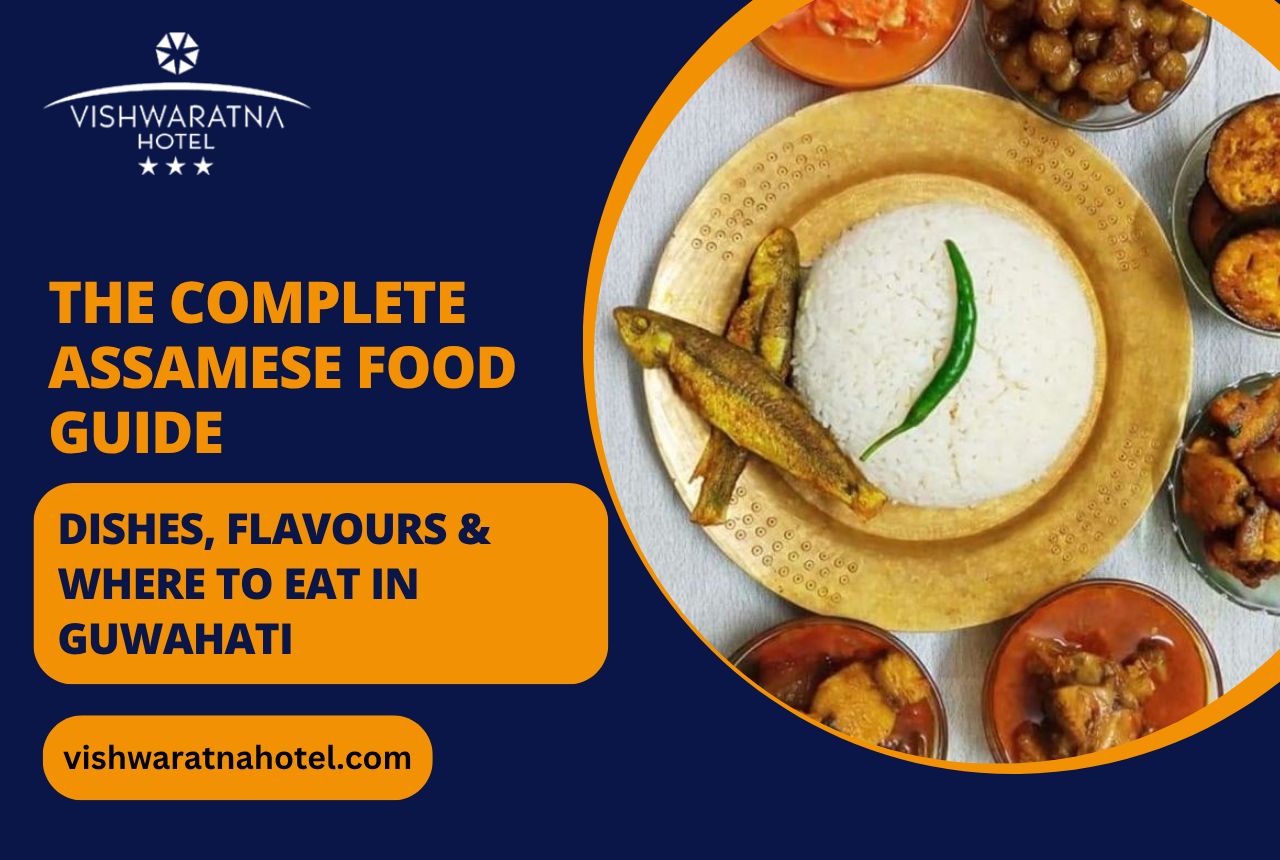
A traditional Assamese thali is structured around four essential components:
- Khar (Alkaline Starter): The meal always begins here. This digestive-alkaline preparation made from banana-tree ash filtrate is unique to Assam. It cleanses the palate and prepares the digestive system. No other Indian cuisine opens a meal this way.
- Xaak (Greens): Seasonal leafy vegetables — mustard greens (xorioh xaak), ferns (dhekia xaak), water spinach — lightly sauteed with minimal seasoning. Often the most nutritionally dense course on the plate.
- Maas or Mangkho (Fish or Meat): The heart of the meal. River fish is preferred — rohu, catla, snakehead, or the prized kawoi (climbing perch). For non-vegetarians, duck, pigeon, or pork are beloved occasion meats.
- Tenga (Sour Curry): The meal closes with tanginess. Masor Tenga (sour fish curry) with tomato, lemon, or elephant apple is as essential to the Assamese table as dal is to a Bengali one.
Tamul-Paan (betel nut with betel leaf) rounds off the meal as a digestive — a ritual that has survived thousands of years unchanged.
The Essential Assamese Food Guide: 12 Dishes You Must Try
Here is your curated list — not a generic roundup, but the dishes that define Assamese identity, in the order a traditional meal would serve them.
1. Khar — The Alkaline Opening Act
Khar is prepared by filtering water through the dried ashes of the sun-dried outer skin of a plantain banana. The resulting alkaline liquid is called kola khar. It is cooked with raw banana, papaya, or lentils into a subtle, earthy dish with a mild soap-like finish that is surprisingly addictive.
In Assam, the phrase ‘Khar Khuwa Asomiya’ (Khar-eating Assamese) is a point of cultural pride. Nutritionally, khar is believed to aid digestion, reduce acidity, and cleanse the gut. Modern food scientists have started examining its prebiotic potential.
Where to try it: Ask for the traditional thali at any authentic Assamese restaurant in Guwahati’s Paltan Bazaar or Fancy Bazar areas.
2. Masor Tenga — The Soul of Every Assamese Table
If you eat only one Assamese dish in your life, make it Masor Tenga. This tangy fish curry uses mustard oil, turmeric, tomato (or lemon, or elephant apple called ou tenga), and a lightly fried piece of river fish. The result is a broth that is simultaneously light, bright, and deeply satisfying.
Unlike North Indian fish curries heavy with cream or coconut milk, Masor Tenga is almost watery in consistency. You pour it over steamed rice and let the sour-savoury liquid soak through every grain. It is summer food at its finest.
Pro tip: The best Masor Tenga uses fresh rohu or catla from the Brahmaputra — the flesh holds its texture in the acidic broth better than farmed fish.
3. Patot Diya Maas — Fish Wrapped in Banana Leaf
This preparation is pure Assamese instinct. Fresh fish is marinated in a paste of mustard seeds, garlic, ginger, green chilli, turmeric, and salt. It is then wrapped tightly in a banana leaf and roasted directly over a wood fire or coal.
The banana leaf does two things: it steams the fish in its own juices and infuses it with a subtle green, grassy fragrance. The result tastes like the best version of simplicity — smoky, herbal, and clean on the palate.
4. Aloo Pitika — The Ultimate Comfort Food
Pitika means ‘mash’ in Assamese. Aloo Pitika is mashed potato combined with raw mustard oil, finely chopped onion, green chilli, and fresh coriander. No butter. No cream. Just the pungency of raw mustard oil cutting through the starch.
It sounds simple because it is. But every Assamese person will tell you that nothing in the world beats a bowl of plain rice, dal, and aloo pitika on a rainy afternoon.
5. Paro Manxho — Pigeon Meat Curry
Pigeon (paro) is considered a delicacy in Assam — slow-cooked with ginger, garlic, onion, and local spices. The meat is darker and more flavourful than chicken, with a slightly gamey note that pairs beautifully with joha rice (a fragrant Assamese short-grain rice).
Paro Manxho is traditionally served at feasts, during festivals, and as an offering of respect to special guests.
6. Haah Mangkho — Duck Curry
Duck (haah) cooked Assamese-style is a winter staple, particularly in rural households. The most celebrated version is Haah Joha Kumura — duck slow-cooked with a fragrant variety of ash gourd that releases aromas similar to joha rice. The fat of the duck melts into the broth over a wood fire, creating a rich, deeply savoury curry unlike anything else in the region.
7. Laai Xaak Gahori — Pork with Mustard Greens
Tender cuts of pork, slow-cooked until the fat renders down, combined with fresh laai xaak (mustard greens) that wilt and soften into the braising liquid. The seasoning is barely there: ginger-garlic paste, green chilli, salt, and turmeric.
The simplicity is the genius. The pork fat flavours the greens; the greens cut the richness of the pork. It is one of the most naturally balanced dishes in Assamese cooking.
8. Kumol Saul Jolpan — No-Cook Morning Bowl
Kumol Saul is a unique variety of parboiled rice that requires no cooking. You soak it in water for a few minutes, drain, and serve with milk or curd, a drizzle of jaggery, and a local banana variety (sondha kol or malbhog kol). It is one of the fastest, most nourishing breakfasts on earth.
Jolpaan (Assamese breakfast culture) centres around this rice alongside chira (flattened rice), muri (puffed rice), and pitha-guri (rice flour with jaggery). It is the kind of morning meal that sustains farmers through a full day in the fields — and it will sustain you through a full day of sightseeing.
9. Til Pitha — The Bihu Festival Rice Crpe
During Magh Bihu (January harvest festival), every Assamese home fills with the smell of rice being pounded and sesame being roasted. Til Pitha is a soft crepe made from soaked rice ground to a fine paste, spread thin on a hot tawa, filled with a mixture of roasted black sesame seeds and jaggery, and rolled up.
Biting into a freshly made Til Pitha is a genuinely moving experience. The outer layer is delicate and slightly chewy; the filling is nutty, warm, and sweet without being cloying.
10. Ghila Pitha — Deep-Fried Jaggery Doughnut
Round, golden, deep-fried discs of rice flour and jaggery. Ghila Pitha (also called tel pitha) is the indulgent counterpart to the delicate Til Pitha. It is crisp on the outside, slightly chewy inside, and caramelised throughout. Eaten warm off the pan, it is Bihu season in a single bite.
11. Tilor Laru and Narikolor Laru — Festival Sweets
Laru (or ladoo) in Assam comes in two essential varieties: Tilor Laru (roasted sesame + jaggery, rolled into balls) and Narikolor Laru (freshly grated coconut slow-cooked with jaggery or sugar until fragrant). Both are prepared during Bihu, gifted to neighbours, and eaten with chai on cold January mornings.
12. Judima and Apong — Tribal Rice Beers
Assam is home to over 200 varieties of indigenous rice, and its tribal communities use this resource to produce remarkable fermented rice beers. Each community has its own recipe and name:
- Judima: The Dimasa tribe’s rice beer, fermented with forest herbs. It has a mildly sweet, earthy flavour and is served in bamboo cups.
- Apong: The Mising tribe produces two varieties — Nagin Apong (white, milder) and Po:ro Apong (darker, stronger).
- Jou: The rice beer of the Bodo and Tiwa communities, traditionally served to welcome guests.
These beverages are not mere drinks — they are ritualistic, medicinal, and deeply tied to community identity. Experiencing them respectfully is part of understanding Assamese culture.
Quick Reference: Assamese Dishes at a Glance
| Dish | Local Name | Must-Try For |
| Masor Tenga | Maasor Tenga | First-time visitors |
| Khar | Kola Khar | Culture & authenticity seekers |
| Patot Diya Maas | Patot Diya | Smoky-flavour lovers |
| Aloo Pitika | Aloo Pitika | Vegetarians, comfort food fans |
| Paro Manxho | Paro Manxho | Meat adventurers |
| Til Pitha | Til Pitha | Festival / sweet lovers |
| Kumol Saul Jolpan | Kumol Saulor Jolpan | Breakfast explorers |
| Duck with Ash Gourd | Haah Joha Kumura | Winter visitors, foodies |
| Judima / Apong | Tribal Rice Beer | Cultural immersion travellers |
Assam Tea: The World’s Most Famous Cup, Made Here
No Assamese food guide is complete without addressing Assam tea. The Brahmaputra valley produces some of the most recognised black teas in the world — bold, malty, and with a distinctive amber liquor that inspired the British to build an entire empire of tea commerce here in the 1830s.
The tea you drink in an Assamese home is different from what you find in five-star hotels. Freshly boiled in water, sometimes with a small amount of milk and rarely with sugar, it is meant to be tasted directly. The terroir of Assam tea is the loamy, well-drained alluvial soil of the Brahmaputra plains — a combination that cannot be replicated anywhere else.
When in Guwahati, visit a tea garden or at minimum seek out a teashop that serves single-estate Assam tea. It will permanently change how you drink your morning cup.
Where to Eat Authentic Assamese Food in Guwahati
Guwahati is the gateway city to Northeast India and the best place to experience the full breadth of Assamese cuisine. Here is where to focus your eating:
Neighbourhood Dhabas in Paltan Bazaar
The unpretentious lunch spots around Paltan Bazaar serve the most honest Assamese thali in the city. Arrive between 12:00 and 14:00. Look for blackboards that list the day’s xaak and fish preparations. Sit at a shared table, order the thali, and let them fill your plate.
Fancy Bazar Food Stalls (Jolpaan Culture)
The morning food culture of Fancy Bazar is worth waking up for. Vendors set up by 7:00 AM selling chira with doi (curd), kumol saul, and fresh pitha during festival seasons. This is everyday Assamese breakfast life — genuinely one of the most pleasant food experiences in the city.
Fish Markets Near the Brahmaputra Ghats
If you are curious about the variety of Assamese river fish — rohu, catla, goroi, kawoi, puthi — the fish markets near Uzan Bazar give you the full picture. Watching the morning catch arrive by boat and seeing locals select their fish is a food education in itself.
Hotel Vishwa Ratna Restaurant
Guests at Vishwa Ratna Hotel have direct access to authentic Assamese preparations curated by our kitchen. From our morning Jolpaan spread to our signature Masor Tenga and Patot Diya Maas dinner service, we ensure that every meal tells you something true about this extraordinary food culture.
We partner with local suppliers and Brahmaputra fishermen to source fresh fish daily. Our kitchen uses no artificial flavour enhancers and follows traditional preparation methods passed down through local culinary knowledge.
Vegetarian Assamese Food: Underrated and Exceptional
Many travellers assume that Assamese food is predominantly meat-based. This is a misconception worth correcting.
The vegetarian tradition in Assamese cooking is deep and varied. Here are the dishes vegetarian visitors should prioritise:
- Khar with raw banana and lentils (completely plant-based, uniquely satisfying)
- Aloo Pitika with raw mustard oil (the national comfort food of Assam, no exaggeration)
- Dhekia Xaak (stir-fried fern fronds with garlic — wild, earthy, and unlike any cooked green you have tried)
- Xorioh Paat Xaak (mustard greens sauteed in mustard oil — pungent, warming, addictive)
- Bora Saul with jaggery and curd (sticky rice eaten as a sweet snack or simple breakfast)
- Kumol Saul Jolpan with banana and jaggery (the easiest, most nourishing meal in the Assamese repertoire)
- Narikolor Laru and Tilor Laru (coconut and sesame sweets — vegan by default, essential during Bihu)
The abundance of seasonal greens in Assam means that a purely vegetarian meal here is never a compromise — it is a full exploration of the land’s flavours.
Conclusion
Assamese cuisine does not announce itself with bold colours or heavily spiced aromas. It reveals itself slowly — in the clean tang of a Masor Tenga, in the earthy warmth of a freshly made Til Pitha, in the elegant simplicity of fish wrapped in a banana leaf and roasted over fire.
This is food that has been shaped by a river, a climate, and a people who have always understood that the best cooking does not try to mask ingredients — it honours them.
Whether you are visiting Guwahati for two days or two weeks, make space in your itinerary for real Assamese eating. Order the thali. Try the khar even if it sounds unusual. Ask for Masor Tenga at dinner. Wake up early for Jolpaan. And if you are here in January, find a Magh Bihu celebration and eat Til Pitha while it is still warm from the fire.
You will not regret it. You may never stop thinking about it.
Frequently Asked Questions About Assamese Food
Q: What is the most famous Assamese dish?
A: Masor Tenga (tangy fish curry) is widely considered the most iconic Assamese dish. It is present in virtually every traditional Assamese meal and is the clearest expression of the cuisine’s preference for sour, light, and fresh flavours over heavy spicing.
Q: Is Assamese food spicy?
A: No. Assamese cuisine is notably mild compared to most Indian regional cuisines. It uses very little chilli heat and almost no heavy whole spice blends like garam masala. The defining flavours are sour (from tenga), alkaline (from khar), smoky (from banana-leaf cooking), and fresh (from seasonal herbs and greens). If you are sensitive to spice, Assamese food will feel like a revelation.
Q: What is khar in Assamese food?
A: Khar is an alkaline preparation unique to Assam, made by filtering water through the dried ashes of a banana tree skin. The alkaline filtrate (kola khar) is used as both a cooking ingredient and a natural digestive. It is typically cooked with raw banana, papaya, or lentils and served as the first course of a traditional Assamese meal. The Assamese people are sometimes affectionately called ‘Khar Khuwa Asomiya’ (Khar-eating Assamese) because of how central this dish is to their identity.
Q: When is the best time to experience Assamese festival food?
A: Magh Bihu (January) and Rongali Bihu (April) are the two best times. During Magh Bihu, traditional foods like Til Pitha, Ghila Pitha, Tilor Laru, and tribal rice beers are made in almost every household. Community feast grounds (called bhelaghar) are set up outdoors with large fires and shared meals. It is one of the most immersive food-cultural experiences in all of Northeast India.
Q: Where can I eat authentic Assamese food in Guwahati?
A: Authentic Assamese food is found in local dhabas in Paltan Bazaar and Fancy Bazar, at morning food stalls for traditional Jolpaan breakfast, and at hotels that specifically curate Assamese cuisine. Vishwa Ratna Hotel in Guwahati offers a curated Assamese menu featuring fresh river fish, traditional khar preparations, and festival-season specials, using locally sourced ingredients.
Q: What rice varieties are special to Assam?
A: Assam is home to over 200 indigenous rice varieties. The most important for food lovers to know are: Joha Saul (a fragrant short-grain rice similar to jasmine rice, often served with duck or mutton), Bora Saul (glutinous sticky rice used for pithas and as a snack), and Kumol Saul (a parboiled variety that requires no cooking — simply soaked in water and eaten with curd or milk). These varieties cannot be found outside Assam and represent one of the world’s most extraordinary agricultural heritages.