

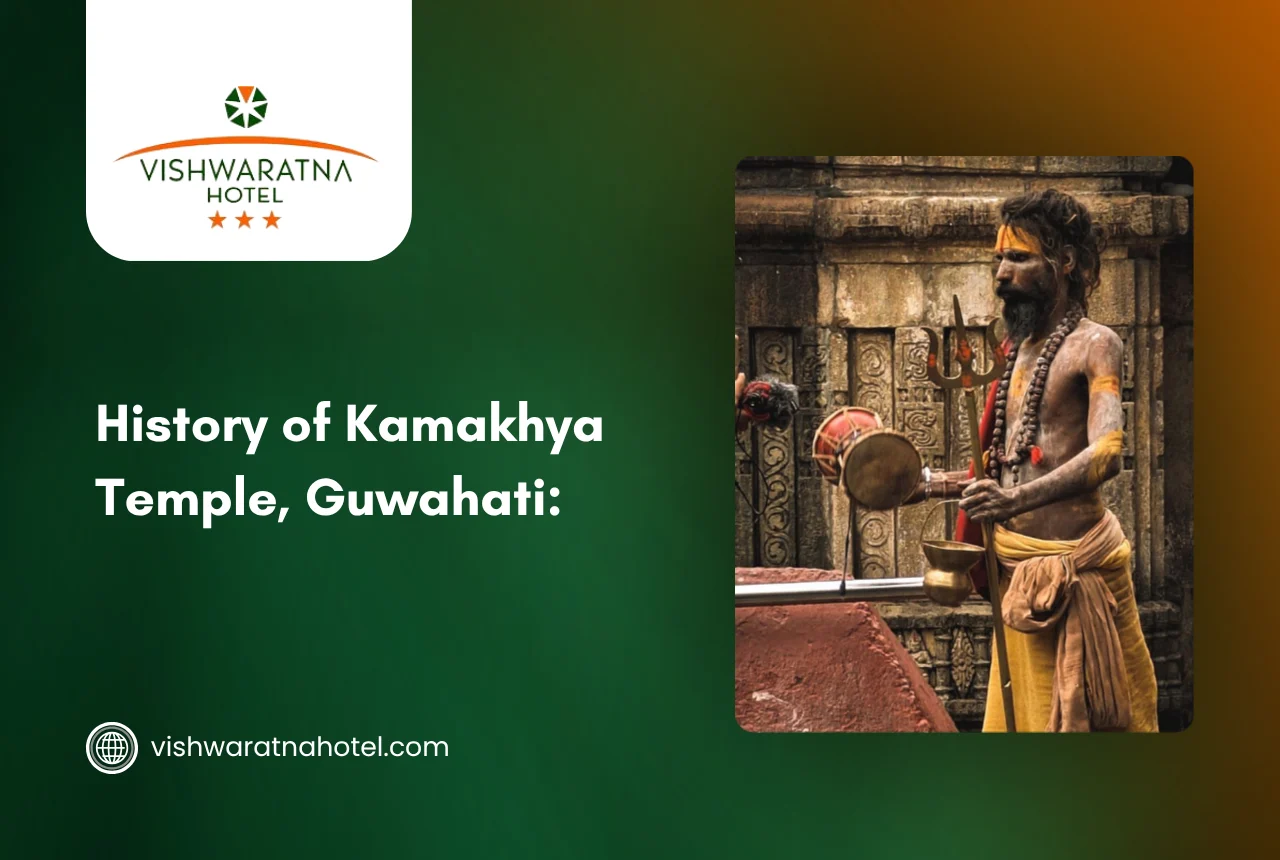
Perched on Nilachal Hill overlooking the Brahmaputra River, Kamakhya Temple is one of the oldest and most revered seats of goddess worship in India. For anyone researching the history of Kamakhya Temple, Guwahati, the story is really three stories layered on top of each other: an ancient myth about the goddess Sati, a documented history of destruction and reconstruction spanning centuries, and a living tradition of Tantric worship that still draws lakhs of pilgrims every year. This guide walks through all three — the legends, the historical record, the architecture, and what to know if you’re planning a visit.
Where Kamakhya Temple Stands: Nilachal Hill and the City of Guwahati
Kamakhya Temple sits on Nilachal Hill (also spelled Nilanchal), a low hill on the western edge of Guwahati with sweeping views of the Brahmaputra as it curves through the Assam valley. The hilltop location was almost certainly deliberate — high ground overlooking a major river is a recurring choice for early Shakti and Tantric shrines across eastern India, offering both a natural defensive advantage and a commanding, symbolically elevated setting for goddess worship. Guwahati itself has been a seat of political and religious power since ancient times, known in early texts as Pragjyotishpura, which helps explain why a temple of this stature developed here rather than in a smaller settlement.
The Legend of Sati: How Kamakhya Became a Shakti Peeth
The most widely told origin story ties Kamakhya to the Puranic legend of Sati and Shiva. According to the Kalika Purana, Sati — Shiva’s consort — immolated herself after her father, Daksha, insulted Shiva by excluding him from a grand yajna. Grief-stricken and enraged, Shiva carried Sati’s body across the cosmos in a destructive dance (the Tandava), and Vishnu, to calm him, cut the body into pieces with his discus. Wherever a part of Sati’s body fell, a Shakti Peeth — a seat of the goddess’s power — was established. Tradition holds that her yoni (womb/reproductive organ) fell at Nilachal Hill, which is why Kamakhya is worshipped not through an idol but through a natural rock formation shaped like a yoni, kept moist by an underground spring inside the temple’s sanctum. This makes Kamakhya one of the most important of the 51 Shakti Peeths recognised across the subcontinent, and the only one where the goddess is worshipped purely in this symbolic, aniconic form.
The Legend of King Naraka and the Divine Architect
Local legend adds a second layer to the origin story, this one tied to Naraka, a Danava (demon) king associated with ancient Pragjyotishpura. As the story goes, Naraka desired to marry the goddess Kamakhya and, to prove himself worthy, was tasked with building a stairway (or, in some versions, the temple itself) from the base of the hill to the summit in a single night. He very nearly succeeded — with the help of the divine architect Vishwakarma — until the goddess, unwilling to marry him, had a rooster crow before dawn to trick Naraka into believing morning had come and the task had failed. Whatever its historical basis, this legend is still told locally and is part of why Kamakhya’s mythology feels distinct from many other Shakti Peeths — it fuses Puranic Shakti worship with an older, regional narrative tradition specific to Assam.
What Archaeology Tells Us About the Temple’s Real Age
Beyond mythology, there’s a genuine, layered construction history. Radiocarbon dating of the temple’s foundation has suggested that the earliest structure on the site may go back roughly 2,000 years, placing some form of shrine here well before the current medieval temple was built. Historians differ on exactly when a major stone temple first stood on Nilachal Hill — some point to the 4th–5th century CE, others to the 8th–10th century under the Pala dynasty’s influence over the region — but there’s broad agreement that Kamakhya was already an established pilgrimage and Tantric centre by the early medieval period, referenced in texts like the Kalika Purana and the Yogini Tantra.
Destruction by Kalapahar and Rebuilding by the Koch Kings
The most consequential event in the temple’s documented history is its destruction in the 16th century. Historical accounts credit the invading general known as Kalapahar with destroying the temple around 1553 CE, during a campaign against Hindu temples in the region — the original medieval structure was largely levelled. The revival came from the Koch dynasty: King Biswasingha, the dynasty’s founder, began reviving rituals and patronage at the site in the early 1500s, and his son, King Naranarayana, undertook the full reconstruction, starting the work around 1555 CE and completing it by 1565 CE. Most of what visitors see at Kamakhya today — the core temple structure — dates from this 16th-century Koch-era rebuilding, though it has been renovated and added to by subsequent rulers and institutions over the following centuries.
Architecture of Kamakhya Temple: The Nilachal Style
Kamakhya’s architecture is often described as its own regional style — sometimes called the Nilachal style — blending elements of the North Indian Nagara temple tradition with local Assamese design. Its most recognisable feature is a beehive-shaped dome (shikhara) rising over the sanctum, quite different from the tall, straight spires seen in temples further north or south. The complex is arranged as a cluster of chambers leading to the Garbhagriha, the innermost sanctum, which — unlike most Hindu temples — holds no idol. Instead, pilgrims descend a short flight of steps to view and touch the natural rock fissure representing the goddess, kept perpetually moist by a spring. Surrounding the main shrine are smaller temples dedicated to the ten Mahavidyas (forms of the goddess), and the complex’s carvings historically referenced the sixty-four Yoginis and eighteen Bhairavis of Tantric tradition — a visual reminder that Kamakhya isn’t just a Shakti Peeth but one of the principal centres of Tantric Hinduism in India.
Kamakhya as a Living Centre of Shakti and Tantra
What sets Kamakhya apart from many ancient temples is that it never became a purely historical monument — it remains an active centre of Shakti and Tantric worship. Practices here, including rituals connected to Tantric traditions and, historically, animal sacrifice as an offering to the goddess, have continued for centuries with relatively little interruption. Sadhus, tantrics, and pilgrims from across India and abroad still travel to Kamakhya specifically because of this unbroken tradition, which is part of why the temple carries a different atmosphere from more purely ceremonial pilgrimage sites.
Ambubachi Mela: The Festival That Defines Kamakhya
No account of Kamakhya’s history is complete without the Ambubachi Mela, the temple’s most significant annual festival, usually held in mid-June at the onset of the monsoon. The festival marks the belief that the goddess undergoes her annual menstrual cycle during this period, symbolising the fertility of the earth and its capacity for regeneration as the monsoon rains begin. The temple closes its doors for three days during the mela and reopens with a large public darshan on the fourth day. One detail that draws particular curiosity is that the Brahmaputra near the temple is sometimes observed to take on a reddish tint during this period — devotees read this as a sign of the goddess’s cycle, while others attribute it to natural sediment, iron content, or ritual offerings in the water. Regardless of explanation, Ambubachi Mela draws lakhs of devotees, including Naga sadhus and Tantric practitioners from across the country, making it one of the largest religious gatherings in Northeast India.
Why Kamakhya Temple Still Matters Today
Kamakhya’s importance today is really twofold. Religiously, it remains one of the most significant Shakti Peeths in the subcontinent and a major centre for Devi and Tantric worship, drawing pilgrims year-round, not just during Ambubachi Mela. Economically and culturally, it’s one of the primary reasons travellers visit Guwahati at all — it anchors religious tourism for the entire city and the wider Northeast India region, and its history is closely tied to Assam’s own political history, from the ancient kingdom of Pragjyotishpura through the Koch and Ahom periods.
Planning Your Visit to Kamakhya Temple
The temple is typically open from around 8:00 AM to 1:00 PM and again from 2:30 PM to 5:30 PM, though timings can shift around festivals and special occasions, so it’s worth checking current timings before you go. It sits a few kilometres from central Guwahati and is reachable by auto-rickshaw, taxi, or app-based cabs, with both a road route and a rock-cut stairway leading up the hill. For a calmer visit with shorter queues, October to March — Guwahati’s cooler, drier months — is generally considered the best time to visit. If you specifically want to experience Ambubachi Mela, plan for mid-June, but expect very large crowds, longer queues, and hotel rooms in the city booking out well in advance.
Where to Stay Near Kamakhya Temple, Guwahati
If Kamakhya Temple is on your itinerary, where you stay in Guwahati makes a real difference — especially during Ambubachi Mela, when rooms across the city fill up quickly. Vishwaratna Hotel has been serving travellers in Guwahati since 2002, with a central location in the Tokobari/A.T. Road area that puts you within easy reach of Kamakhya Temple and the city’s other major sights, along with comfortable rooms, in-house dining, and event and banquet facilities for families, business travellers, and wedding parties alike. Whether you’re planning a pilgrimage visit, a family trip, or a business stay in Guwahati, get in touch with our team to check availability and book your stay — and if you’re travelling for Ambubachi Mela, we’d recommend booking well ahead given how quickly the city fills up.
Frequently Asked Questions About Kamakhya Temple
What is the history of Kamakhya Temple?
Kamakhya Temple’s history spans Puranic mythology — it’s one of the 51 Shakti Peeths, believed to mark where Sati’s yoni fell — and a documented medieval history in which the original temple was destroyed by the invading general Kalapahar around 1553 CE and rebuilt by the Koch dynasty’s King Naranarayana between 1555 and 1565 CE, forming the structure that largely stands today.
Why is Kamakhya Temple famous
It’s famous as one of the most important Shakti Peeths in India, as a major centre of Tantric Hindu worship, and for the Ambubachi Mela, an annual festival symbolising the goddess’s fertility that draws lakhs of pilgrims and sadhus each June.
Who built Kamakhya Temple?
While legend credits the Danava king Naraka and the divine architect Vishwakarma with an early structure, the temple as it exists today was rebuilt by King Naranarayana of the Koch dynasty in the mid-16th century, after the earlier temple was destroyed by Kalapahar.
What happens during Ambubachi Mela?
The temple closes for three days in mid-June to mark the goddess’s annual menstrual cycle, symbolising the earth’s fertility at the start of the monsoon, then reopens for a major public darshan. It’s one of the largest religious gatherings in Northeast India.
What is the best time to visit Kamakhya Temple?
October to March offers cooler weather and smaller crowds for a typical darshan. Visitors specifically wanting the Ambubachi Mela experience should plan for mid-June, while expecting significantly larger crowds and advance hotel bookings.